
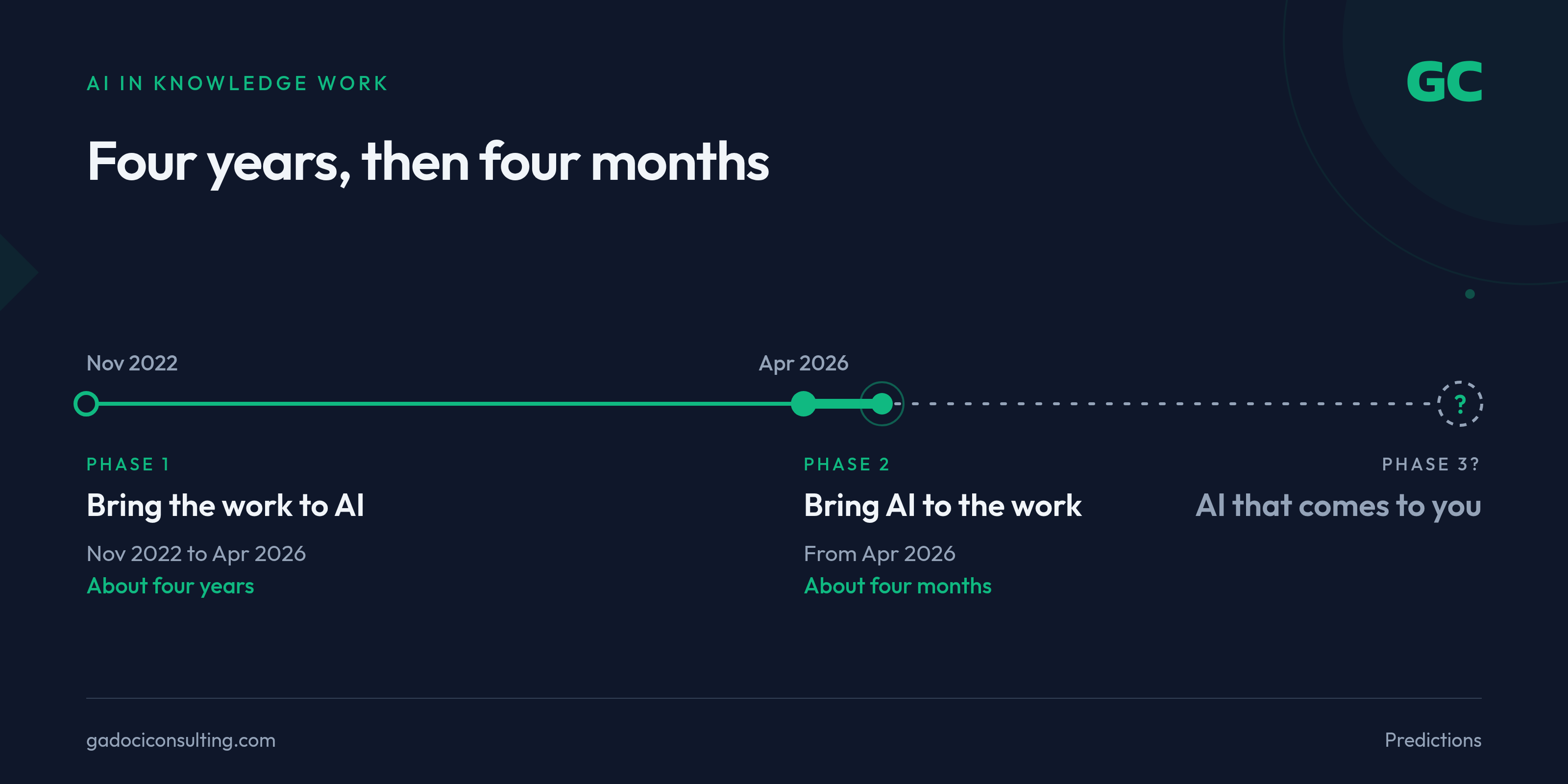
In November 2022, ChatGPT hit the scene and became the fastest-growing consumer application of all time, reaching 100 million users in two months (TikTok took nine). It was magic. Not all of us saw it back then, but over the following four years each of us had our own "aha" moment with AI. November 2022 through April 2026 is what we at Gadoci Consulting call AI in Knowledge Work Phase 1. AI in Knowledge Work Phase 2 started in April 2026, and we thought we had some time to see this phase out. But now, with yet another flurry of new tools, I fear we may see a four-year period collapse to four months, with AI in Knowledge Work Phase 3 already on the horizon. Phase 1 was about bringing our work to AI. Phase 2 is about bringing AI to our work. Phase 3 looks like AI that comes to us. Let's dive in.
AI in Knowledge Work Phase 1 (Bringing Our Work to AI)
It's been quite a journey. When ChatGPT arrived, we all wrote cute poems, children's stories, and rap songs, and we were genuinely impressed as the first real application of "AI" hit the mainstream. For the first time, AI became real for us, presented in an interface that was so familiar, so simple, and so human at the same time: a conversation.
Over the next four years, we watched as a cadre of players joined OpenAI. Anthropic, Google, Microsoft, Perplexity, xAI, Meta, and Mistral all agreed to play the same game: create chat experiences with increasingly capable models and ever-larger context windows, then relentlessly launch features around managing context. Those features showed up as Custom GPTs, Projects, Gems, memory, Canvas and Artifacts, Skills, connectors, and MCP.
In 2022, people first noticed AI. In 2023, they said, "Hey, this might actually be useful." In 2024, people said, "Hey, I might be able to use this for work." In 2025, businesses said, "Hey, hold on, are you using that for work?" And in 2026, leadership stood on stage and said, "We need to be using AI." The resulting effort has been to play the game as it was described over the last four years and learn how to bring parts of our work to AI. And we did. We brought the chat window our files, our ideas, and our requests. We learned to summarize, research, and analyze, all through plain text, and it was magical. And just about the time we said, "Yay! I finally got my ChatGPT/Claude/Gemini set up the way I wanted," it was too late, because the innovation didn't stop there.
AI in Knowledge Work Phase 2 (Bringing AI to Our Work)
To understand Phase 2, start with software development, where 2025 was the year of agentic coding. Much like early knowledge work, developers had been bringing their work (code) to AI through the chat interface. I remember copying and pasting code back and forth between ChatGPT and my IDE. It worked, but it was cumbersome, and the context window was a real problem for longer sessions. Around 800 lines of code was my limit before the genius behind the text box got amnesia.
So the world of AI and code made a shift: it brought the AI to the code. That is, teams built "harnesses" where AI could work on the local computer, in the very codebases developers were working on. These harnesses used a combination of techniques to traverse the file structure, gain understanding, and write code right there in the correct file when necessary.
This worked really well, and companies like Cursor and Windsurf surged. OpenAI tried to buy both, Google hired away Windsurf's founders in a licensing deal, and SpaceX, after merging with xAI, agreed to buy Cursor for $60 billion. But Claude Code from Anthropic took home the prize. By the end of 2025, Claude Code was the talk of the town, and the conversation started to move from the capability of the model to the capability of the model plus the harness. The resulting efficiency gains in software development have been nothing short of a revolution, creating an environment of innovation, exponential execution, and ultimately fear of a SaaSpocalypse.
Knowledge work is about 18 months behind this revolution, and for good reason. Code is a well-defined artifact that AI could easily understand, infer meaning from, and work within. Not to mention, a lot of its training data was code. PDFs, spreadsheets, slide decks, email threads, meeting notes, and the workflows that tie them together proved more challenging. But Anthropic and OpenAI started to realize that Claude Code and Codex (respectively) were being used for more than just coding. Curious non-coders were using these tools as a local implementation of agentic AI to do knowledge work. Acting on that signal, both set out to create a middle-ground product that was easier to use than the terminal, so knowledge workers could do the same type of work and take advantage of the same powerful harness.
In January 2026, Anthropic announced a research preview of Claude Cowork, which went into general availability in April. Those of us who jumped in immediately saw the usefulness of putting the power of the Claude harness on our local computers, pointed at our own folders. Many of us had to relearn the importance of a well-organized local directory so that, like the developers, we could unleash this next evolution of AI for our work. During this time, the combination of Claude, Claude Code, and Claude Cowork let Anthropic close the gap on OpenAI and ChatGPT and become one of the fastest-growing software companies ever, going from $14 billion in annualized revenue in February to more than $30 billion by April, a figure OpenAI disputes.
Just like in 2022, the field was set, and along came the players. OpenAI launched ChatGPT Work, and Amazon tried to adapt and participate with the release of Amazon Quick. Perplexity came back into the conversation with its "Computer" offering. Manus shipped My Computer, a desktop app that lets its agent work in folders you choose. And Microsoft brought Copilot Cowork, built on Anthropic's models, to Microsoft 365.
This is what we at Gadoci Consulting call AI in Knowledge Work Phase 2. We've been doing AI Embeds with tools like Claude Cowork and ChatGPT Work since March of this year. We called this shift early, and we thought we had more time. Phase 1 took four years, after all.
AI in Knowledge Work Phase 3? (AI That Comes to Us)
In the last couple of months, we've seen the release of Grok Bot, Meta Muse, ChatGPT Dots, and now, as of this week, Claude Duet. One of these things isn't quite like the others, but it's close. Grok Bot launched in August with a fundamentally different approach than its chat-interface predecessors and introduced the idea of multiple, simple, orchestrated "bots." These are essentially subagents, already used in the likes of Claude Code/Cowork and ChatGPT Work/Codex, but with a different product design. Plus, in my use, Grok Bot makes scheduled and recurring tasks more of a first-class citizen in the UX than they are in those tools.
Grok Bot is a bit of a bridge to Muse, Dots, and Duet. The latter three take the metaphor even further. They wrap the orchestrated subagent experience into proactive bots with context and opinions, abstracting away much of the complexity that those of us on the front edge of AI have been orchestrating ourselves.
Admittedly, these three products are aimed more at individual users than at the enterprise, but I can tell you from using Grok Bot personally that it starts to feel a lot like a step function in the evolution of AI for knowledge work. Perhaps not quite there yet. But if it truly is a step function, then Phase 1 of knowledge work lasted four years and Phase 2 lasted about four months, counting to Grok Bot's arrival in August. Again, that's what you'd expect with exponential innovation.
Where We Stand
This recent set of offerings is not ready for the enterprise yet. Larger companies should focus on ramping their teams through Phases 1 and 2, taking their companies through the AI adoption journey (access, usage, incorporation, and leverage), and keeping an eye on Phase 3, where the puck is going, without getting distracted. The ecosystem is hardening enough around offerings like Claude Cowork and ChatGPT Work that real knowledge work can be done.
In practice, that means three things: get your teams onto Claude Cowork or ChatGPT Work, organize the folders and files those tools will work in, and practice inside real workflows rather than demos. That's the work we do in our AI Embeds.
All this to say, things are moving fast. Part of our work here at Gadoci Consulting is to notice patterns before our clients do. The future will keep changing, but the good news is that if you learn the fundamental skills and concepts needed for Phase 1, you will be ready for Phases 2, 3, 4, and beyond. This is an additive journey, and like anything else, the more you know, the more you can learn.
Sources
- ChatGPT sets record for fastest-growing user base - analyst note (Reuters, via INQUIRER.net, February 2023)
- Microsoft makes Copilot Cowork generally available worldwide (Redmond Magazine, June 16, 2026)
- Anthropic says it hit a $30 billion revenue run rate after 'crazy' 80x growth (VentureBeat, 2026)
- OpenAI launches ChatGPT Work (BNN Bloomberg, July 9, 2026)
- xAI wants in on the enterprise with Grok Bot (Reworked; launched August 11, 2026)
- Meta debuts its Muse AI agent (TechCrunch, September 8, 2026)
- OpenAI launches Dots, its bubbly agentic avatar (TechCrunch, September 29, 2026)
- Anthropic launches Claude Duet, a proactive AI agent (MacRumors, October 21, 2026)
- OpenAI looked at buying Cursor creator before turning to AI coding rival Windsurf (CNBC, via NBC Washington)
- The exclusivity on OpenAI's $3 billion acquisition of Windsurf has expired (Fortune, July 11, 2025)
- SpaceX acquires Cursor for $60 billion (Techzine Global, June 16, 2026)
- Claude release notes (Anthropic; Cowork research preview January 12, 2026, general availability April 9, 2026)
- Introducing My Computer: When Manus Meets Your Desktop (Manus, March 16, 2026)