Gadoci Consulting AI Brief
A shape is emerging in how we work with AI
Thanks for signing up. Each issue has three parts: what's happening in AI, one thing to try, and a story from the field. It's longer than a post and shorter than an article.
What's happening in AI
A shape is emerging.
Looking back at how people have worked with AI, I see three phases. The first two are clear. The third is just starting.
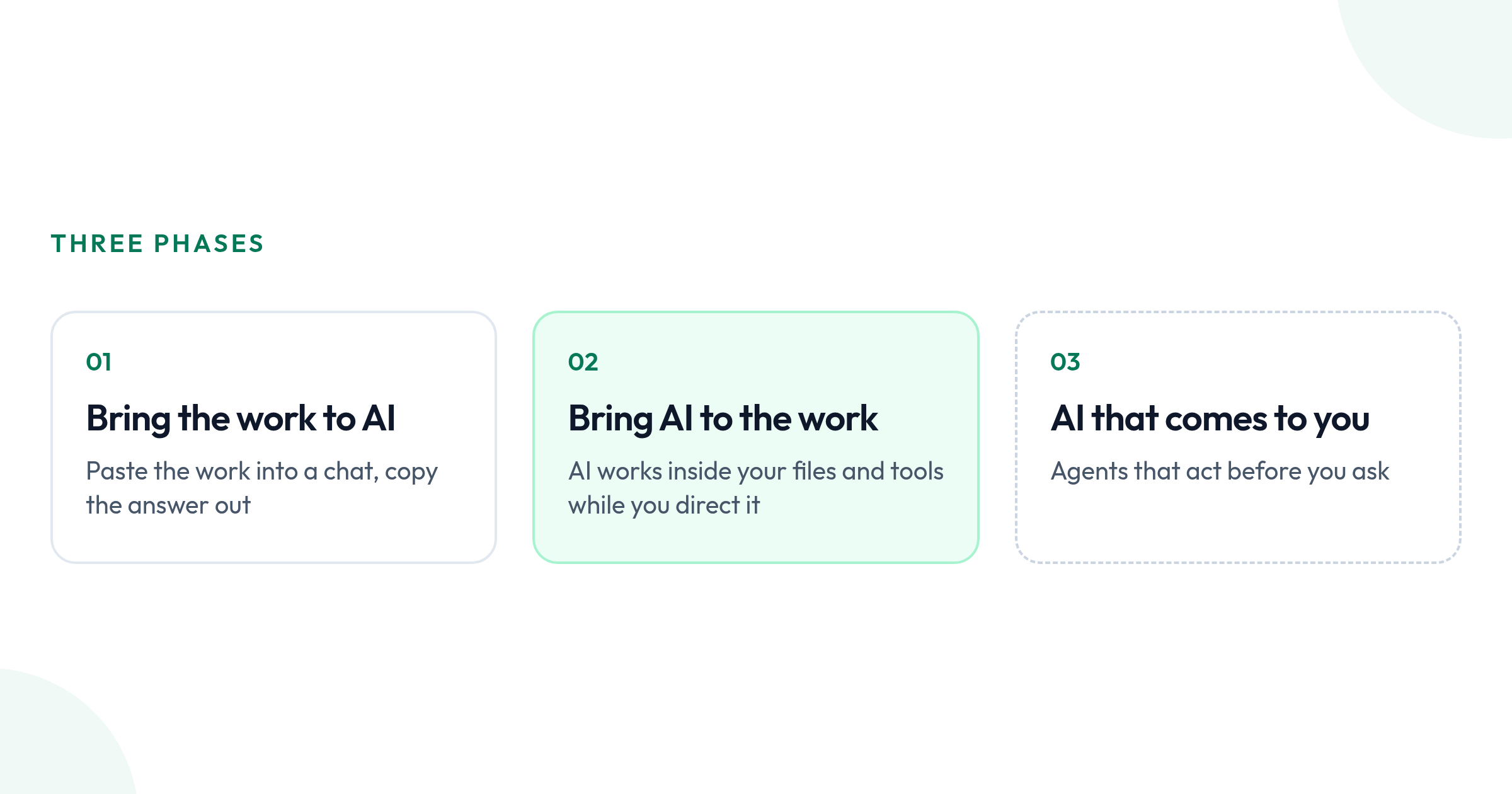
Phase 1: Bring the work to AI. From ChatGPT's launch in November 2022 until this spring, most of us worked the same way. Open a chat, paste in the work, copy the answer back out. It helped, but the work and the AI lived in different places, and you were the bridge.
Phase 2: Bring AI to the work. Since this spring, more of us have been working with AI inside our files and apps. Claude Cowork and ChatGPT Work take a goal, work across the files and tools you connect, and hand back finished documents, spreadsheets, and slides while you direct them. Most teams are here now, and most are still learning it.
The vendors are pushing further in this direction:
- Anthropic has started merging Claude's chat and Cowork into one Claude, so you no longer pick a mode before you start. It's rolling out to Pro and Max plans first.
- Since October 6, new Cowork tasks on Pro and Max plans run in Anthropic's cloud, so the work keeps going after you close your laptop.
- OpenAI is retiring custom GPTs on December 11. Migrating one turns its instructions into a skill inside a plugin. Only the GPT's creator (or a workspace admin) can migrate it, so if your team relies on someone else's GPT, ask them now.
Phase 3: AI that comes to you. Next come agents that act before you ask. Claude and ChatGPT can both run tasks on a schedule, and ChatGPT's Scheduled Tasks can also start when an event occurs or watch for changes. A few products are built entirely around it. Meta's Muse is a personal agent that works toward your goals in the background, messages you when something changes, and asks before it sends an email or makes a purchase. OpenAI's dots are always-on agents in ChatGPT, each with its own cloud computer, that look through your connected apps and suggest ways to help. Grok Bot, included with paid Cursor and SuperGrok plans, gives you named AI teammates that work on their own cloud computer and come back when something needs your approval.
One thing to try
Turn your recent AI chats into user stories.
We ran this exercise recently with a group of AI leads. It borrows a basic from good product planning: the user story. A user story describes a need in one sentence, from the point of view of the person who has it: who they are, what they want to do, and why. Product teams write them so everyone stays focused on who the work is for and what outcome matters before anyone picks a tool. Written about your own AI use, they show which chats are repeatable work.
- Open your chat history and pick ten conversations you'd have again.
- Write each one as a one-sentence user story: "As a [role], I want to [task], so that [outcome]." Add how often it comes up and where the inputs live.
- Save the stories as files in one folder.
- Point Claude (in Cowork, if your app still shows that option) or ChatGPT Work at that folder and ask: "For each story, how could this work change if you worked inside my files and tools instead of a chat window? What would you need access to, and what could run on a schedule?"
Some stories will stay quick chats, and that's fine. Look for the one that comes up most often and has its inputs in one place. That's your first candidate for a standing process. We wrote more about the gap between using AI and changing how the work gets done in The Gap Between Using AI and Changing How We Work.
A story from the field
At a media company, one person on the content team spent every weekend tracking down scores so he could publish rankings for a sport that had never had them. The rankings built a real following, but doing it by hand, the team could only cover two sports. They built a tool that pulls public stats from team websites, with AI filling in where the scraping breaks. Partners and staff now see each week's numbers in one place and vote on the rankings. The tool is projected to save 2,000 hours of manual work a year, and the team has added five more sports. Schools and others now reshare the rankings and make their own content around them.
With AI handling the grunt work, a small team now serves audiences it could never have reached by hand.
Thanks for reading.
Brandon Gadoci, Gadoci Consulting