Gadoci Consulting AI Brief
Access to AI is becoming part of the offer
What we're seeing
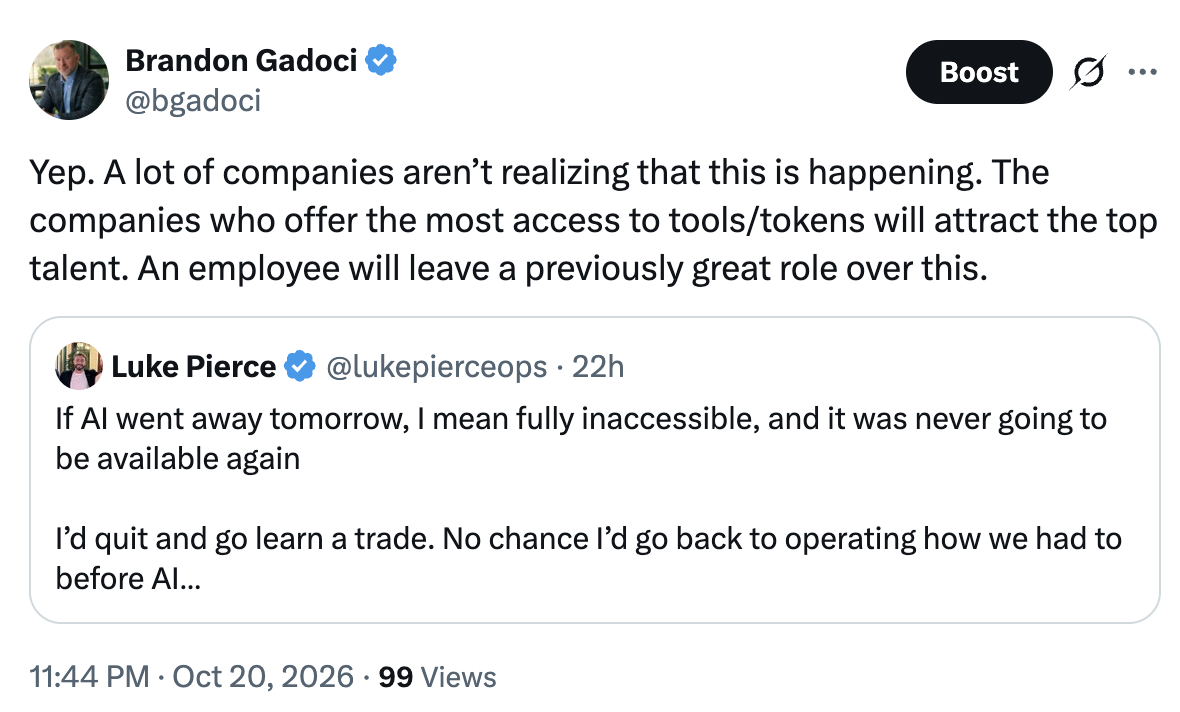
Luke Pierce posted that if AI disappeared tomorrow, he'd quit and go learn a trade. A lot of companies aren't seeing what that means. People who've gone deep with AI don't want to work without it. Access to tools and tokens is becoming part of the offer, the way pay and remote work did. The companies that give the most access will get the best people, and some will leave a role that used to be great because they're being rationed. If your guidance to the team is still some version of "go easy on it," that's worth a second look.
What's happening in AI
Always-on agents arrived four months into Phase 2.
We've been describing AI in knowledge work in phases. Phase 1 was the chat window, from ChatGPT's launch in November 2022 until this spring, when we brought our work to AI. Phase 2 started in April, when AI products like Claude Cowork and ChatGPT Work began bringing AI to our work, inside our own files and apps.
About four months later, a different kind of product started showing up: always-on agents that keep track of your work and come to you when something needs attention. Grok Bot came first in August, then Meta's Muse and ChatGPT's dots in September. This week Anthropic joined them with a research preview of Claude Duet. Duet sends a short morning brief on what matters across your connected apps, messages you only when something needs you, and asks before it sends, pays, signs, or deletes anything. It's waitlist only for now, starting with US Pro and Max subscribers. (Anthropic, Oct 21)
We're still working out whether this is Phase 3 or an extension of Phase 2. The label matters less than the pace. Phase 1 took about four years. If this is Phase 3, Phase 2 lasted about four months, and most companies we work with are still in Phase 1 or just moving into Phase 2. We lay out the full picture in Four years, then four months.
In brief
Microsoft will sell Copilot without a Microsoft 365 base subscription. Starting December 1, new Microsoft 365 Copilot licenses can be bought on their own, though what Copilot can do still depends on the Microsoft 365 apps you're licensed for. New Copilot Business licenses bought through partners in supported markets will also turn on pay-as-you-go billing by default, and that default lets each person run up to 4,000 Copilot Credits a month in pay-as-you-go charges, for features like Copilot Cowork, until an admin changes it. If you buy that way after December 1, set that limit on purpose before the first bill. (Microsoft, Oct 14)
If your team uses Claude, Claude Design is probably already on. It turns a description into a first version of a design, prototype, or one-pager, and once someone loads your company's brand kit (fonts, colors, and components), it builds with that so the work matches your brand. On Oct 8, Anthropic took Design, Docs, and Slides out of beta on every Claude plan, including Free, added Dashboards (paid plans) and Motion (Team and Enterprise) as new betas, and on Oct 15 turned Design, Docs, and Slides on by default for Enterprise organizations, except HIPAA-enabled ones. Ask someone on your creative, product, or marketing team to make one real piece in it this week, like a one-pager or a launch graphic. (Anthropic, Oct 8; Claude Design FAQ, Oct 15)
ChatGPT is catching up with a shared deck editor of its own. Less than two weeks after Claude Slides left beta, OpenAI started rolling out ChatGPT Slides for eligible Pro, Business, and Enterprise users with access to Space, ChatGPT's shared workspace, and it's reaching people gradually. You can share an example deck to set the style, teammates can edit the same deck at once and leave comments, and you can export to PowerPoint, PDF, or Google Slides. Next time you build a recurring update deck, give ChatGPT last month's version as the example and see how much formatting work it saves you. (OpenAI, Oct 2026)
One thing to try
Leave brackets for Claude
Claude Docs, the editable document Claude drafts beside your chat, came out of beta this month and is on every plan. We wrote Four years, then four months in it. As you write, leave brackets where you want help, like [add the launch date here] or [two sentences on why this matters]. Keep writing, and every so often tell Claude in the chat to fill in the brackets. It edits the doc in place while you keep going.
A story from the field
Apps Script is getting a second life
Over the past year we've seen a surprising number of people at companies that run on Google Workspace writing Apps Script, Google's small programs that automate work inside Sheets, Docs, and Slides. Most of it is in Sheets, and very few of these people are developers. They ask AI to write the script, paste it into the editor, run it, and paste the error back when it breaks. Coders did the same thing in Phase 1, carrying code to ChatGPT and copying it back. It also shows learning to use AI and automating a workflow running together, as people who started by asking AI for help end up automating parts of their own job. Google added Gemini inside the Apps Script editor in August, and we're curious how this changes in Phase 2 as the AI shows up in the editor instead of another tab.
Thanks for reading.
Brandon Gadoci, Gadoci Consulting