Gadoci Consulting AI Brief
What Anthropic's roadshow says about knowledge work
We think models are already capable enough for most knowledge work.
Anthropic priced its initial public offering on November 18, with trading on the Nasdaq set for November 19 under the ticker ANT. Before the listing, we went to ipo.anthropic.com and watched the roadshow video there.
Early in the video, a frame shows two lines. Intelligence climbs past writing code, evaluating a merger, and running a research lab. The line labeled "Where users are" rises slowly, from summarizing email to finding a restaurant to making a PowerPoint.
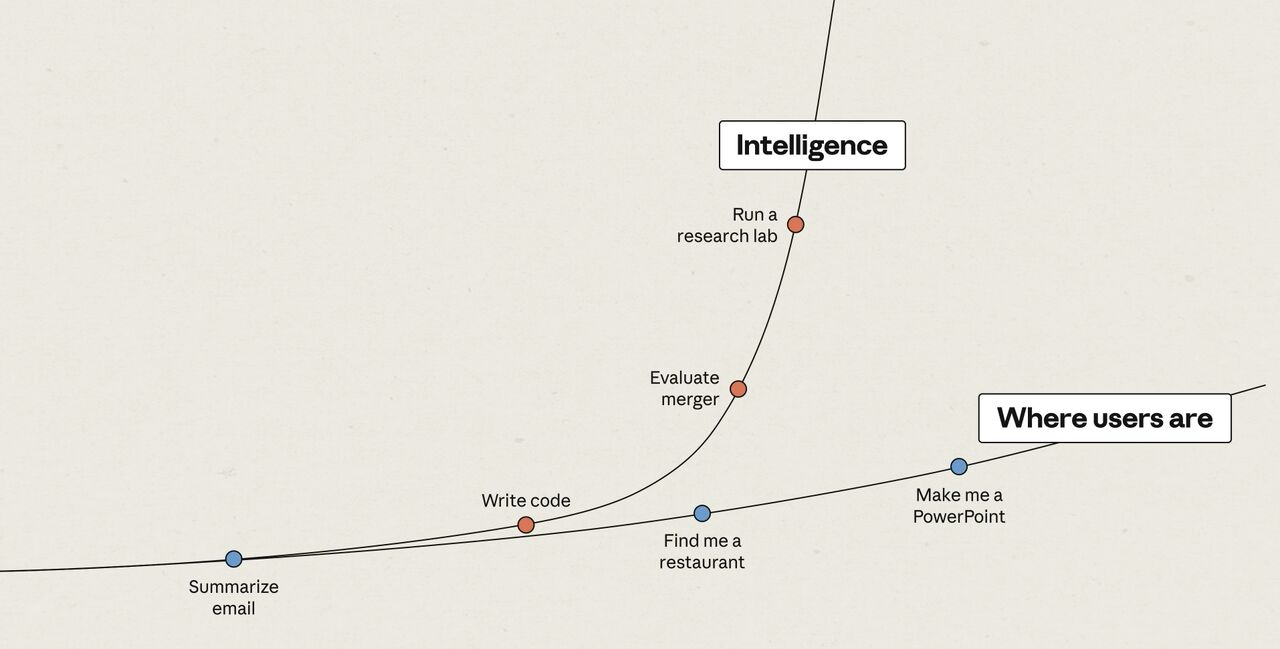
Image: a frame from Anthropic's IPO roadshow video, ipo.anthropic.com
Anthropic's current lineup is Haiku 5.5, Sonnet 5.5, Opus 5.5, and Fable 5.2. Its model guide says to start with Opus 5.5 for most workloads and to use Fable 5.2 for demanding reasoning and long-horizon agentic work, or when Opus 5.5 at higher effort still falls short.
In our view, most enterprise usage doesn't need Fable. Sonnet 5.5 and Opus 5.5 are extremely capable for the work most people do every day. In May we wrote that the frontier models are extraordinarily capable for the vast majority of knowledge work, and that the difference lives in the ecosystem around the model. In July we argued that the model is close to a commodity and the harness is the value: the memory, tools, projects, and workflow that turn a model into something a team depends on daily.
That puts the bottleneck with users. They have a lot of catching up to do and a lot of ground to take. The work now is moving people from using AI to incorporating it into how their work gets done, inside a harness set up for it.
Knowledge work is next in line for the step change.
What surprised us most in the video is that for both coding and cybersecurity, they described improvement, then a step change once a model release crossed a threshold, and then rapid change across the whole category of work. In their telling, coding went from autocompleting a few lines to teams of agents working around the clock in about a year. Their security curve runs from human-led research on one target at a time, past the level of a senior security researcher, toward autonomous security teams.
They spent a lot of time on how the same thing will happen for knowledge work. On their slide, knowledge work sits at early agents today, with a threshold ahead and autonomous fleets of agents beyond it. The slide labels the curve as illustrative.
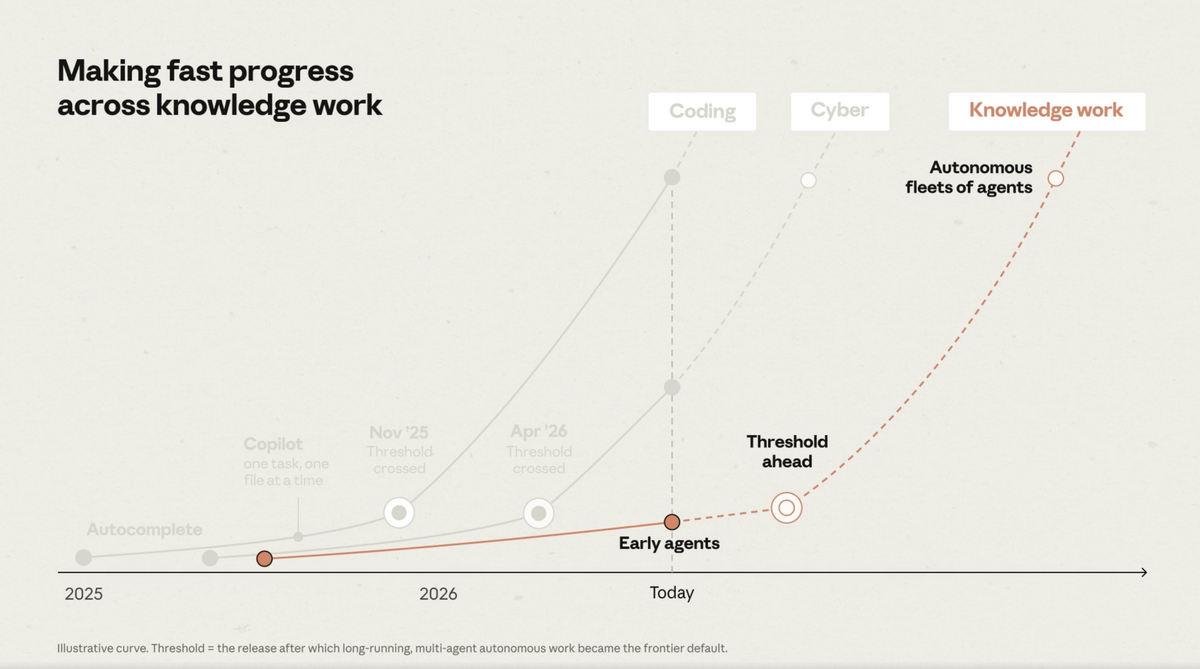
Image: a slide from Anthropic's IPO roadshow video, ipo.anthropic.com
We see the same sequence. In October we wrote that knowledge work is about 18 months behind the revolution in coding. Coding got its harness first, with AI products like Claude Code working inside the codebase. Cowork-style products now bring that harness to the files, folders, and workflows of everyday knowledge work. The roadshow slide puts the curves in the same order. We wrote more about this in Knowledge Work Is Set Up for the Step Change.
We expect the best AI employees to change companies in 2027.
In our prediction, a small group, by our own estimate 5 to 10 percent of people, has gone much further with AI than everyone else, and the old way of working now feels like a downgrade to them. In our view, two things push them out: no path for the work they are doing, and caps on how much AI they can use. In a June 2026 PagerDuty survey of 1,250 office professionals at large companies in four countries, 75 percent said they would be likely to look for a job with better AI skills development. Start by finding your champions and asking each one what is in the way.
People can use AI every day and still keep it away from how their work gets made.
In When the Way We Work Changes Before We Do, Grant Gadoci calls the delay before our beliefs catch up the Belief Lag. Most of the boundaries behind it gather around two working defaults: standards, what we think good work requires, and identity, which work we think is ours to do. They can sound like "I need to understand how this was produced before I put my name on it" or "I'm not the technical one." Some beliefs can take weeks or months to catch up with what AI can now do. Until they do, a usage dashboard shows a healthy user while the work gets made the way it always was. It's part 2 of 4 in his series, The Friction in AI Progress.
New on the site
Knowledge Work Is Set Up for the Step Change.
The best AI employees will change companies in 2027.
Treat Claude and ChatGPT like an operating system, not a tool.
Thanks for reading.
Brandon Gadoci, Gadoci Consulting